
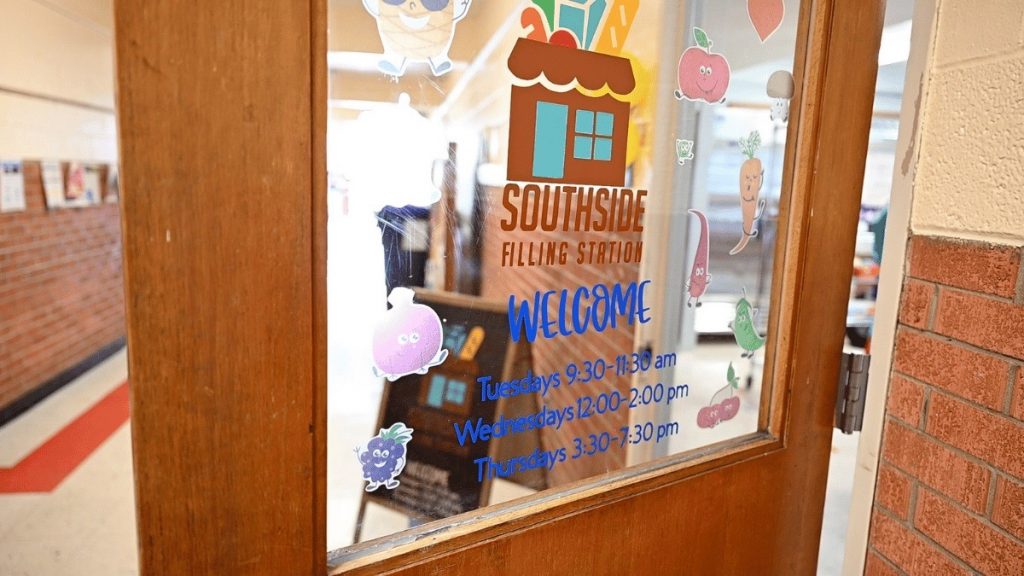
At SENT, we don’t believe food security is the finish line. We believe it is the front door.
For many neighbors, the Southside Filling Station is the first place they feel safe asking for help. It’s where immediate needs are met with dignity and where trust begins to form. From there, deeper support becomes possible. This is why food security is not just one program at SENT — it is a critical entry point into our wraparound model.
Food Is Often the First Need — Not the Only Need
When basic needs aren’t met, everything else becomes harder. Research consistently shows that housing stability, health outcomes, educational success, and economic mobility are all deeply connected to whether families can reliably access food. Hunger increases stress, worsens health conditions, disrupts learning, and forces impossible tradeoffs between rent, utilities, medication, and groceries.
At the Southside Filling Station, we see this every week.
Neighbors don’t come because they’ve failed. They come because the cost of living has outpaced wages, benefits don’t stretch far enough, medical bills pile up, or one unexpected crisis tipped a fragile budget into instability.
In 2025 alone:
- 62% of households served reported annual incomes below $20,000
- 31% reported incomes between $20,000–$39,999
- The median estimated monthly household income was $1,349
- 24% were uninsured
- 31% were enrolled in SNAP
- 35% qualified for free or reduced lunch for their children
These numbers make one thing clear: food insecurity is rarely isolated. It is a signal that something deeper is happening.
Why SENT Runs the Southside Filling Station
SENT operates the Southside Filling Station because food access cannot be separated from the systems that surround it.
In 2025, the Southside Filling Station distributed 303,482 pounds of food — nearly four times more than in 2024 — while keeping the average cost per pound of $0.04, ensuring every dollar stretched further for the community. This growth wasn’t just about volume; it reflected increasing need and increasing trust.
But the Southside Filling Station is intentionally designed to be more than a food pantry.
It is a relationship-centered, client-choice space where neighbors are welcomed, not rushed. Where dignity is protected. Where staff and volunteers have time to listen. And where connections to additional support happen naturally, not forcefully.
As one neighbor shared:
“I‘ve struggled, and I’m not afraid to tell people. I know what it’s like to be asking for food.” – Topeka Mother
That moment matters. Because trust opens doors. This mother is showing her daughter and the rest of the world just how selfless, giving, and resilient single mothers are.
Suzie lives in public housing with her three daughters, Dahlia, Haze,l and Shiloh. She relies on Southside Filling Station, the food pantry at SENT Inc. in Topeka, to access high-priced necessities such as eggs, milk, and meat, and is able to save $100 on groceries.
From Food to Stability: How the Wraparound Model Works
The Southside Filling Station is often described as the mouth of the funnel — the place where many neighbors enter. But it is Neighbor Advocacy that becomes the door.
Neighbor Advocates meet people where they are and walk alongside them as needs unfold. There is no one-size-fits-all path. For some, it’s SNAP enrollment. For others, housing navigation, mental health support, medical care, workforce training, or substance use services.
In 2025, of those who visited the Southside Filling Station:
- 1,463 families (31%) were enrolled in SNAP
- 292 families (6%) were connected to additional SENT services, including case management, mental health care, substance use services, and job readiness
- 7% received mental health services
- 21% expressed interest in taking healthy next steps
- 67% opted into ongoing communication, staying connected beyond a single visit
These connections don’t happen because someone is pressured. They happen because trust is built over time.
A Neighbor Advocate shared:
“I’ve found that the best way to help our community isn’t through a list of services, but through being present in the places where life is actually happening. Seeing a teacher go from sharing her classroom with me to visiting our food pantry a few days later shows the power of a real connection. We aren’t here to ‘fix’ people—we’re here to be a steady neighbor so that when things get tough, there’s already a foundation of trust to lean on.” – Eric Culbertson
Why One Door Matters
Many neighbors have already tried navigating current systems. They’ve told their story again and again, filled out paperwork that went nowhere, and hit dead ends that made asking for help feel exhausting or unsafe.
SENT’s wraparound model is designed to interrupt that cycle.
Instead of asking neighbors to knock on a dozen doors, we work to ensure they only have to walk through one.
The Southside Filling Station creates that first point of connection. Neighbor Advocates help translate immediate needs into long-term pathways. Medical, mental health, housing, workforce, and family supports are coordinated — not siloed.
As another Neighbor Advocate put it:
“I remember a neighbor who kept falling through the cracks because their needs weren’t getting met when systems and resources weren’t communicating with each other. Having one door mattered because it gave them a steady place to land and someone to help connect the pieces, instead of starting over every time. Over time, coordination and relationship didn’t fix everything, but they helped things feel less overwhelming and made real change possible.” – Tricia McCourt, Addiction Specialist
What This Has Meant for the Neighborhood
Between 2024 and 2025, the Southside Filling Station evolved from a growing food access site into a core piece of neighborhood stability infrastructure.
- Food distribution increased by over 280%
- Volunteer engagement grew to 8,253 hours, valued at nearly $190,000
- Operational efficiency improved dramatically
- Most importantly, the Southside Filling Station became a measurable gateway into health, housing, and prevention services
This is what holistic transformation looks like. Not quick fixes. Not isolated programs. But layered, coordinated support that recognizes the complexity of real life.
Food security is not the end of the story — but without it, the story often can’t begin.
At SENT, we start with food because that’s where many neighbors start. From there, we build toward stability, dignity, and long-term thriving — together.