How Campus Connections Wraps Support Around Young People, and the Families Who Love Them
Every school day, there is a window of time that research calls one of the most important, and most overlooked: the hours between 3 p.m. and 7 p.m.
These are the hours when young people are most likely to be alone. Most likely to run into danger. The Office of Juvenile Justice and Delinquency Prevention says these are the peak hours when youth are most likely to be victims of crime, and most likely to commit it.
SOURCE: Office of Juvenile Justice and Delinquency Prevention. (2023). Youth as Victims and Offending by Youth. Statistical Briefing Book. https://ojjdp.ojp.gov/statistical-briefing-book/victims
These are also the hours when one thing can change a young person’s path: a caring adult. A mentor. A program. A safe place to be.
That is why Campus Connections was built.
What Campus Connections Is, and Why It Exists
Campus Connections is SENT Inc.’s school-based prevention program. It wraps support around students, families, and teachers in the Hi-Crest community of Southeast Topeka.
It is not just an after-school program. It is a full system of support. Research shows that young people do not face hard things alone. The stress a student brings to class on Monday may have started over the weekend: maybe there wasn’t enough food at home. Maybe a parent works three jobs. Maybe there was no trusted adult around who knew the student’s name.
Campus Connections is built to address these root causes, not just treat the symptoms.
The program works on three levels:
- Primary prevention: Support for all students that builds strength, connection, and good choices.
- Secondary prevention: Extra support for students showing early warning signs.
- Tertiary prevention: Direct handoffs to mental health and substance use treatment when a student needs it.
By placing services right inside schools, and by getting teachers, families, and other helpers to work together, Campus Connections makes it easier for kids to get help. It catches problems early, before they turn into crises.
The Evidence Behind After-School Investment
The case for after-school programs is not just a feeling. It is backed by decades of research. The finding is always the same: when young people get structured support and strong relationships after school, they do better in almost every part of life.
The Afterschool Alliance studied this in 2024. They found that students who went to high-quality after-school programs regularly scored up to 20 percentile points higher on math tests than students who were regularly unsupervised after school.
Source: Afterschool Alliance, The Latest Research on the Impact of Afterschool and Summer Programs, 2024, https://afterschoolalliance.org/documents/The-Latest-Research-on-the-Impact-of-Afterschool-and-Summer-Programs-2024.pdf
The same research tracked teens over time. Students who joined organized activities after school at ages 15 and 18 were much less likely to misuse drugs at age 26. On the other hand, high schoolers who spent unsupervised time with peers after school were much more likely to binge drink and smoke marijuana regularly by age 26.
Source: Afterschool Alliance, The Latest Research on the Impact of Afterschool and Summer Programs, 2024, https://afterschoolalliance.org/documents/The-Latest-Research-on-the-Impact-of-Afterschool-and-Summer-Programs-2024.pdf
A 2023 study looked at 56 different after-school programs. It focused on young people with marginalized identities, including youth of color and youth from low-income communities. It found a real, positive effect on their people skills, mental health, behavior, and sense of identity.
Source: Christensen et al., Journal of Community & Applied Psychology, 2023, via Afterschool Alliance 2024, https://www.cebmentoring.org/wp-content/uploads/2023/09/Community-Applied-Soc-Psy-2023-Christensen-1.pdf
These are not just numbers about strangers far away. These are numbers about real students, sitting in real classrooms right now at Eisenhower Middle School and Highland Park High School.
What Campus Connections Looked Like in 2025
In 2025, Campus Connections served 877 students. They came from four partner schools: Ross Elementary School, Eisenhower Middle School, Highland Park High School, and Avondale Academy.
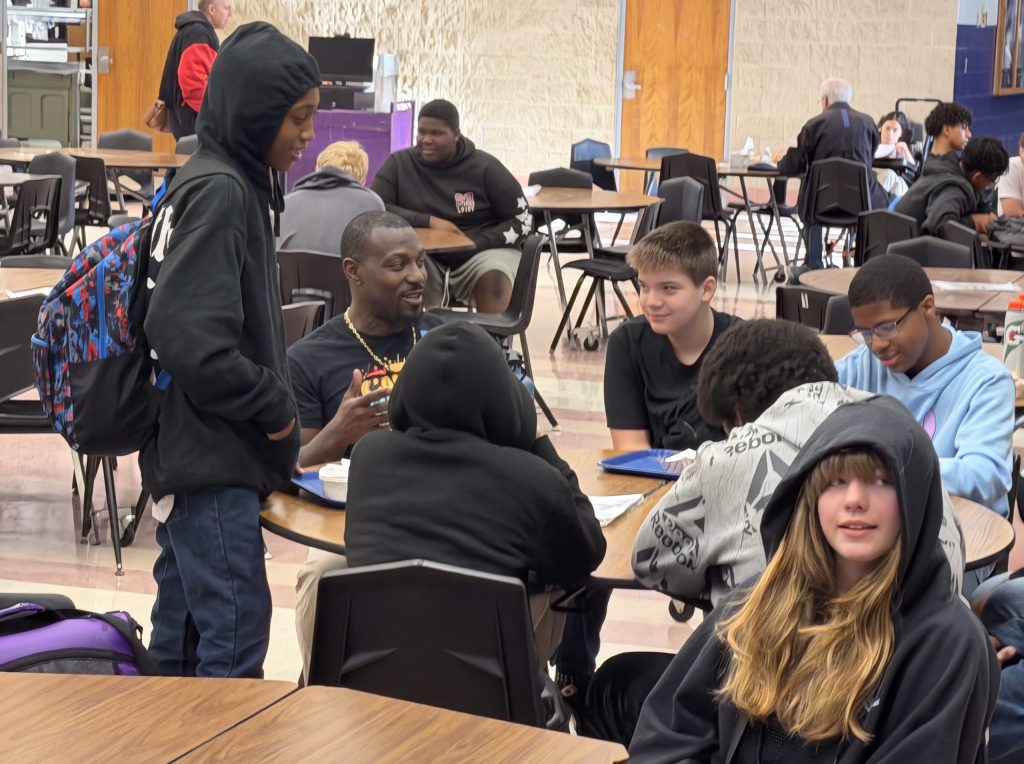
Students got mentoring, music therapy, prevention lessons, mental health services, and family support, all working together.
Programs included:
- Work In Process, a live concert built around mental health.
- Bridge Builders Investment Club, which pairs teens and their caregivers to learn about money together.
- Making Sense of Your Worth, a group program that builds resilience.
- And TBRI® training for 30 teachers, which helps them lower the effects of stress and trauma in the classroom before things get worse.
What made 2025 stand out was not just how much the program offered. It was the purpose behind it. Campus Connections invested in students, in caregivers, and in the teachers who show up for both, every single day. In a wraparound model, everyone in a student’s life matters.
The Wraparound Connection: One Student. One Family. One System.
What makes Campus Connections different is not any single program. It’s the way the programs connect to each other.
Here are some examples:
- A student joins Creative Expressions. Then, a staff member notices something is wrong and connects the student to mental health counseling.
- A caregiver joins Bridge Builders and mentions they’re worried about losing their housing. Then, a Neighbor Advocate steps in to help.
- A teacher is struggling with money problems, so someone connects them to food help at the Southside Filling Station. That support helps the teacher stay present for the students who need them.
Campus Connections sits at the crossroads of school, family, and community. It’s not something you join and then leave. It’s a relationship that follows a student for up to four years, with the same mentors and the same caring adults showing up again and again. Research tells us that steady, long-term support like this matters most.
The Afterschool Alliance’s 2024 research backs this up: kids who show up several days a week, for months and years, see the biggest gains. The benefits build slowly over time. Showing up again and again is what makes the program work.
Source: Afterschool Alliance, The Latest Research on the Impact of Afterschool and Summer Programs, 2024, https://afterschoolalliance.org/documents/The-Latest-Research-on-the-Impact-of-Afterschool-and-Summer-Programs-2024.pdf
That’s why Campus Connections is built around four-year groups of students, called cohorts. One good afternoon isn’t enough. But four years with the same caring adults, the same community, and a door that’s always open? That can change a student’s whole path in life.
What’s Coming This Fall: A Bigger Campus Connections Launches September 2026
Everything built in 2025 set the stage for what’s coming this fall.
Starting in September 2026, Campus Connections becomes a 4-day, after-school program at Eisenhower Middle School. It’s open to students from Eisenhower Middle School, Highland Park High School, and Avondale Academy. Buses will bring students from those high schools, so getting a ride is never the reason a student misses out.
The program runs Monday through Thursday, from 3:00 to 4:45 p.m. It is completely free for every student and family who joins.
Eight partner groups have signed on. Together, they offer a rotating set of activities built around one simple idea: Connect. Create. Build. Serve.
- One Heart Project — mentoring and building relationships in small groups
- Theater & Performance — local theater professionals help build confidence, storytelling, and stage presence
- Creative Expressions — art and music as therapy
- Work In Process — live music that supports mental health and prevention
- Bridge Builders Investment Club — money skills for teens and caregivers together
- Coding and Video Game Development — led by SRO Officer Tim Bell
- Fellowship Hi-Crest Generation — teaching video and audio production skills
- 4-H Youth Development, through K-State Extension — life skills and leadership
- Volunteer and Civic Engagement — service and connecting with the community
Academics are woven into everything. 80% of program time integrates academic support — including tutoring and hands-on learning that reinforces what students are working on in class.
Students join a group, or cohort, that stays together for up to four years. The adults in the program will learn their names, their interests, and their goals. Families are part of the plan from day one. A parent or caregiver must sign the student up, on purpose, because Campus Connections is built to support the whole family, not just the student who walks through the door.
Why Families Are Not an Afterthought. They’re the Point.
It would be easy to build an after-school program that only focuses on students. Many programs do, and that work matters too.
But SENT’s wraparound model is built on a different idea: a student’s wellbeing can’t be separated from their family’s wellbeing. If a caregiver is under heavy financial stress, that stress lives inside the home. If a parent doesn’t know what help is out there, that help never gets used. If the adults in a student’s life aren’t supported, the student feels it too.
That’s why Campus Connections wraps support around the whole family. It connects caregivers to Neighbor Advocates, to the Southside Filling Station, to money skills classes, to mental health services, and to everything else in SENT’s wraparound model.
One door. One relationship. A path that grows based on what each family actually needs.
Enrollment Is Open Now
The fall 2026 pilot group is limited to 24 students, and will grow to 40 as the program expands. Registration is open now. Spots go to whoever signs up first.
Campus Connections is 100% free. Always.
Register at: senttopeka.churchcenter.com/registrations/events/3689065
Learn more about the program: senttopeka.com/campus-connections
Questions? info@SENTtopeka.com | (785) 783-2535
Works Cited
- Afterschool Alliance, The Latest Research on the Impact of Afterschool and Summer Programs, 2024, https://afterschoolalliance.org/documents/The-Latest-Research-on-the-Impact-of-Afterschool-and-Summer-Programs-2024.pdf
- Office of Juvenile Justice and Delinquency Prevention. (2023). Youth as Victims and Offending by Youth. Statistical Briefing Book. https://ojjdp.ojp.gov/statistical-briefing-book/victims
- Christensen, K. M., Kremer, K. P., Poon, C. Y. S., & Rhodes, J. (2023). A meta-analysis of the effects of after-school programmes among youth with marginalized identities. Journal of Community & Applied Psychology. https://onlinelibrary.wiley.com/doi/abs/10.1002/casp.2681
- Christensen et al., Journal of Community & Applied Psychology, 2023, https://www.cebmentoring.org/wp-content/uploads/2023/09/Community-Applied-Soc-Psy-2023-Christensen-1.pdf
- Hsieh, T., Simpkins, S., & Vandell, D. (2022). Longitudinal associations between adolescent out-of-school time and adult substance use. Journal of Adolescence, Vol. 95, No. 1. https://pubmed.ncbi.nlm.nih.gov/36250338/
- SENT Inc. Campus Connections 2025 Year-End Data. (Internal program report.)